

If you’ve ever sat down to work and looked up two hours later with little to show for it, you’re not alone. Distraction is the default state of modern work. The Pomodoro Technique is one of the simplest and most popular time management methods for fighting it. It uses short, bursts of focus separated by breaks.
This guide explains what the Pomodoro Technique is, how it works and why people find it effective.
What Is the Pomodoro Technique?
The Pomodoro Technique is a time management method in which you work in focused intervals, traditionally 25 minutes long, separated by 5 minute breaks. Each interval is called a “Pomodoro.”
Italian developer Francesco Cirillo created the method in the late 1980s while he was a university student. He used a tomato shaped kitchen timer to track his study sessions. Pomodoro is the Italian word for tomato, and the name stuck.
The idea is simple: instead of facing a huge task or a never ending project, you commit to only one small block of undistracted effort at a time.

How the Pomodoro Technique Works In Practice
- Choose one task. Pick something specific, a small part of a bigger task, like “write the intro section” rather than “write the whole blog.”
- Set a timer for 25 minutes. It counts as one Pomodoro.
- Do it with full focus. No phone, switching tabs, or any other distractions. If something pops into your head, jot it down and return to the main task.
- Take a 5 minute break when the timer rings. Stand up, stretch, drink some water, and remember to look away from your screen for a bit.
- Repeat. After completing 4 Pomodoros, take a longer break of 15 to 30 minutes.
That’s the whole system. Its advantage is that it’s easy to get started and easy to repeat.
Why the Pomodoro Technique Works
It lowers the barrier to starting
Most of the time, procrastination comes from the emotional weight of a task. “Work on this project for three hours” feels like signing up for suffering, when your brain does the math, it negotiates for later. But “work for 25 minutes” feels doable. You’re not committing to finish anything but this one small focus session.
And here’s the trick: once you’ve started, the hardest part is already behind you. Starting is the biggest challenge, and the Pomodoro technique shrinks it.
It protects your attention
Every time you check a notification, or mentally switch to another task, you drain your energy. Research on task switching suggests it can take over 20 minutes to fully regain deep focus after an interruption, you may have experienced this after answering “one quick message”
A fixed interval gives you a rule: during this block, one task only. You don’t have to re-concentrate every time a distraction appears, the decision was already made when you pressed start.
It builds in recovery
Focus is like a muscle. Long, uninterrupted stretches of focusing feel heroic but quickly accumulate fatigue, by mid afternoon you’re reading the same paragraph three times. Regular 5 minute breaks act like recovery intervals between sets in the gym: brief and frequent enough that your attention never gets pushed past its limit.
Many people find their focus holds up better across the whole day with breaks built in. You’re trading a slightly slower hour for six or seven hours that don’t collapse.
It makes time measurable
How long will something take is a question most of us answer wrong. We underestimate by instinct, which is why projects run over schedule. Counting completed Pomodoros turns vague effort into a specific number. After a few weeks you learn things like: “a real report costs me six Pomodoros, not two” or “my mornings are worth about ten Pomodoros, my afternoons about five.”
It’s valuable data. You can quote work more accurately, plan your day against your actual capacity, and stop being surprised by your own workload.
It creates momentum
Each finished session is a small win, the timer rang, you did what you said you’d do. That tiny hit of accomplishment triggers a real motivational loop, success makes you more willing to start the next session, and the next one after that.
Four Pomodoros into a task and you’re still rolling. That’s also why the technique works best when you protect the streak. Ritual matters.

Who Uses the Pomodoro Technique?
- Students use it to study and write essays without burning out.
- Software developers use it to protect deep work from interruptions.
- Writers and designers use it to get past blank page paralysis.
- Remote workers use it to create a daily routine.
- People with attention challenges often find short defined intervals easifer to manage.
Tips for Doing the Pomodoro Technique Well
Plan your Pomodoros before you start
The technique begins even before the timer starts. Spend five minutes writing down what you intend to accomplish, then make a rough estimate of how many sessions each task will demand. This small act of estimation does two things: it forces you to define what “done” looks like for each task, and it gives you a reference you can compare against later. Over time, your estimates become more accurate, which is itself a valuable skill.
Protect the interval
A Pomodoro only works if it’s treated seriously, which is why the technique’s founder insisted that a disrupted session doesn’t count, you start over. In practice, most of us can’t ignore every interruption, so use a compromise: keep a notepad beside you and the moment something intruding pops into your head or arrives at your desk, write it down and keep going. This habit is very powerful, it acknowledges the interruption without letting it reduce your attention.
Take real breaks
The break isn’t meant to be filled with more stimulation, it’s the mechanism that makes the whole focus cycle sustainable. Scrolling social media might feel like resting, but it keeps your brain in a state of low level stimulation and leaves you returning to focus just as tired as before. Instead, stand up and physically step away from your workspace. Stretch, get a glass of water, step outside for a breath of air, or simply look out a window and let your eyes focus on something distant.
Group small tasks
Not every Pomodoro needs to be a dive into deep work. Some chores like answering emails, scheduling meetings or filing expenses can nibble away at your entire day if you let them. Instead, batch them: dedicate one Pomodoro purely to clearing messages or handling quick errands, and treat it with the same seriousness. This gives you the satisfaction of finishing them in one sweep while preventing them from fragmenting the sessions reserved for meaningful work.
Review at the end of the day
The Pomodoro Technique is more than a timer, but only if you actually read the data. At the end of the day, take five minutes to look back, how many sessions did you complete, which tasks took twice as long as estimated, and where did interruptions come from? It turns each day into a small experiment with results you can learn from. Every insight is worth having. Over weeks, this habit transforms the technique from a gimmick into understanding of how you work best.

Common Pomodoro Mistakes
- Skipping breaks to push through, which usually backfires by afternoon.
- Choosing vague tasks, which makes it hard to know when you’ve made progress.
- Checking your phone mid-session, which breaks the focus the method depends on.
- Treating the 25 minutes as sacred when it doesn’t fit. If you’re in a genuine flow state, it’s fine to extend a session. The structure serves you, not the other way around.
Using a Pomodoro Timer App
You can run the technique with a kitchen timer, but a Pomodoro timer app makes it easier to track the results. A good app handles the countdown and breaks automatically, so you don’t have to think about them.
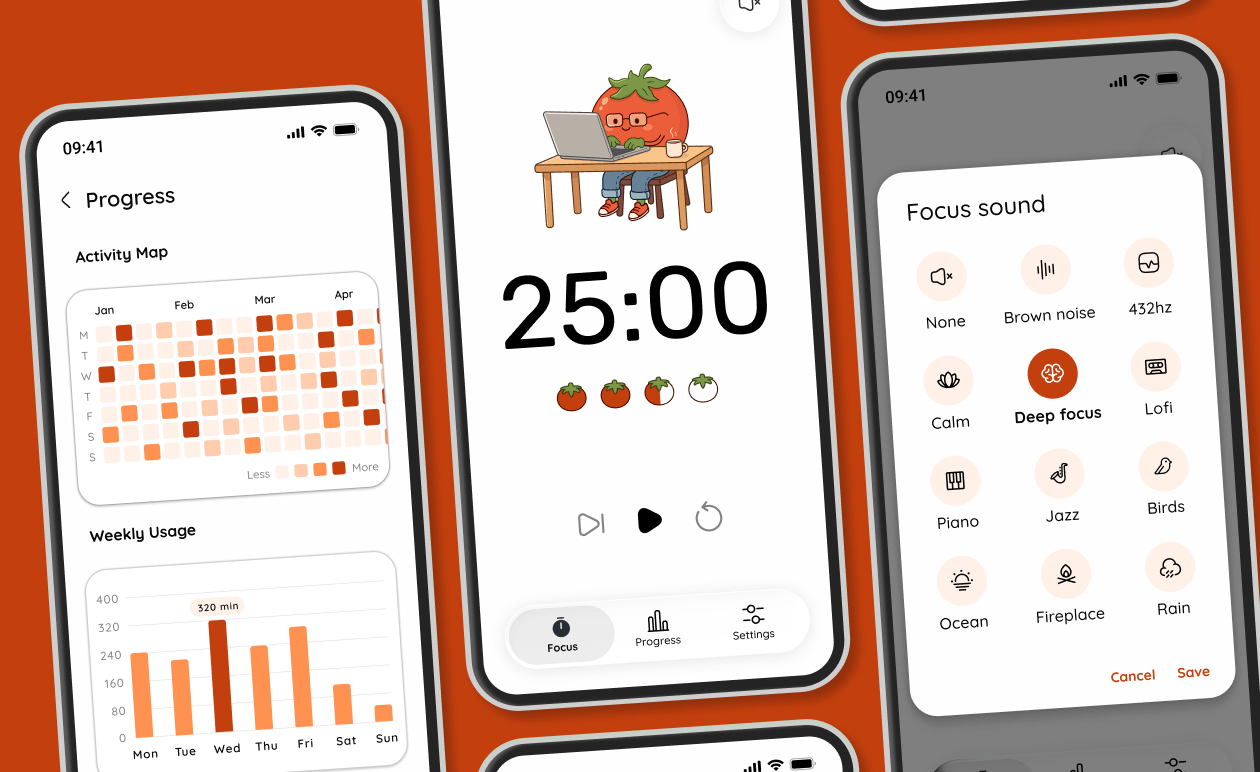
Apps like PomPom go a step further. PomPom is a focus timer for your phone that tracks your sessions and turns them into charts, so you can see how much you focus each day, which times of day you work best, and how your habits change over weeks. Seeing your focus data helps you answer practical questions, such as:
- How many Pomodoros do I actually complete on a typical day?
- Am I more focused in the morning or the afternoon?
- Is my focus time growing or shrinking over the month?
Tracking this turns the technique into a habit you can measure and improve.
Frequently Asked Questions
Is the Pomodoro Technique really 25 minutes?
25 minutes is the traditional length, but it’s a starting point. Many people adjust it to suit their tasks and attention span.
How many Pomodoros should I do per day?
It varies by job and energy. Many people aim for somewhere between 6 and 12. Start small and increase gradually rather than chasing a high number.
What if I finish my task before the timer ends?
Use the remaining time to review or improve your work, a practice Cirillo’s method encourages, rather than stopping early.
Can I use the Pomodoro Technique for studying?
Yes. It’s popular with students because it breaks long study sessions into manageable blocks with built-in rest.
What’s the best Pomodoro timer app?
The best app is the one you’ll actually use. Look for a simple timer, customizable session lengths, and progress tracking such as focus statistics and charts.
The Pomodoro Technique works because it’s simple: pick a task, focus for a short block, rest, and repeat. It reduces procrastination, protects your attention, and makes your progress visible. Try a few sessions today, adjust the timing to fit you, and use a focus timer with charts to see how your habits improve over time.
Ready to try it? Download PomPom on App Store or Play Store and start tracking your focus sessions today.